Documentation Index
Fetch the complete documentation index at: https://dify-6c0370d8-fix-language-redirection.mintlify.app/llms.txt
Use this file to discover all available pages before exploring further.
データソース(Data Source)プラグインは、Dify 1.9.0で新たに導入されたプラグインタイプです。ナレッジパイプライン(Knowledge Pipeline)において、ドキュメントデータのソースとして機能し、パイプライン全体の開始点となります。
この記事では、データソースプラグインの開発方法(プラグインの構造、コード例、デバッグ方法など)を紹介し、プラグインの開発と公開を迅速に完了させるお手伝いをします。
事前準備
この記事を読む前に、ナレッジパイプラインのプロセスに関する基本的な理解と、プラグイン開発に関する一定の知識があることを確認してください。関連する内容は、以下のドキュメントで確認できます:
データソースプラグインのタイプ
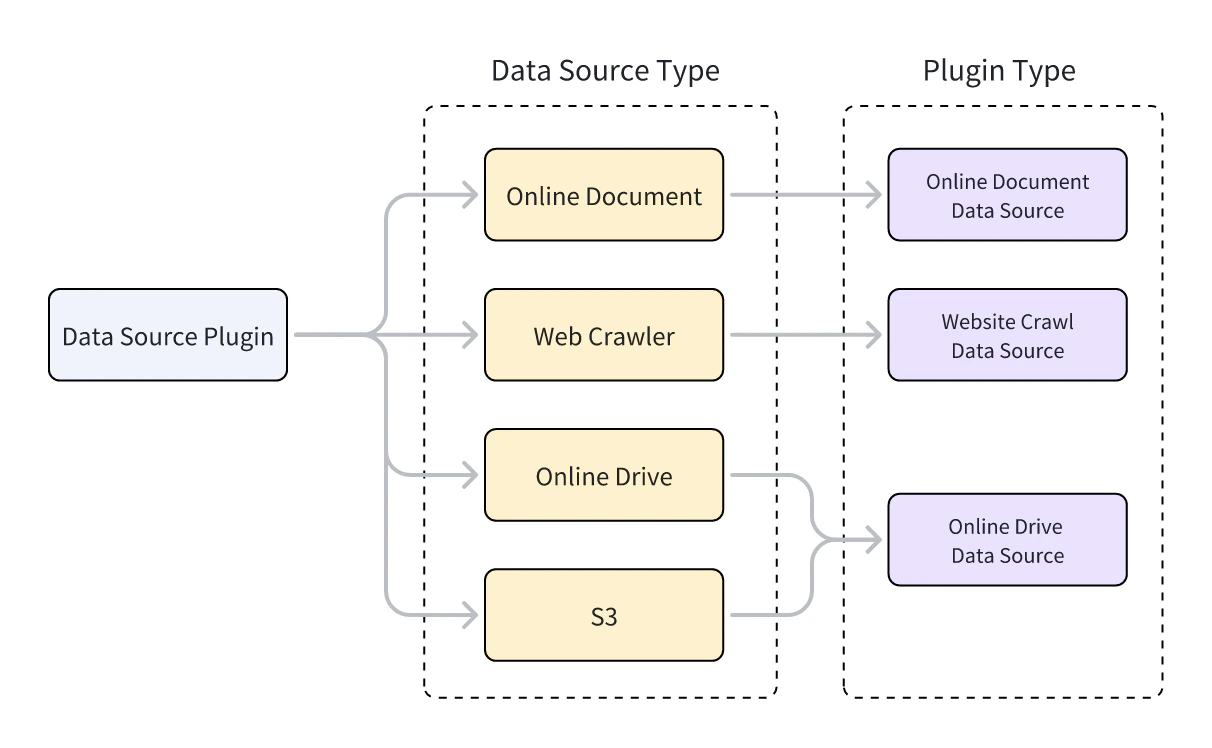
Difyは、Webクローラー、オンラインドキュメント、オンラインストレージの3種類のデータソースプラグインをサポートしています。プラグインのコードを具体的に実装する際には、プラグイン機能を実現するクラスが異なるデータソースクラスを継承する必要があります。3つのプラグインタイプは、3つの親クラスに対応しています。
各データソースプラグインタイプは、複数のデータソースの設定をサポートしています。例:
- Webクローラー:Jina Reader、FireCrawl
- オンラインドキュメント:Notion、Confluence、GitHub
- オンラインストレージ:Onedrive、Google Drive、Box、AWS S3、Tencent COS
データソースのタイプとデータソースプラグインのタイプの関係は、以下の図の通りです:
プラグインの開発
データソースプラグインの作成
スキャフォールディングのコマンドラインツールを使用して、データソースプラグインを作成し、datasource タイプを選択できます。設定が完了すると、コマンドラインツールが自動的にプラグインのプロジェクトコードを生成します。
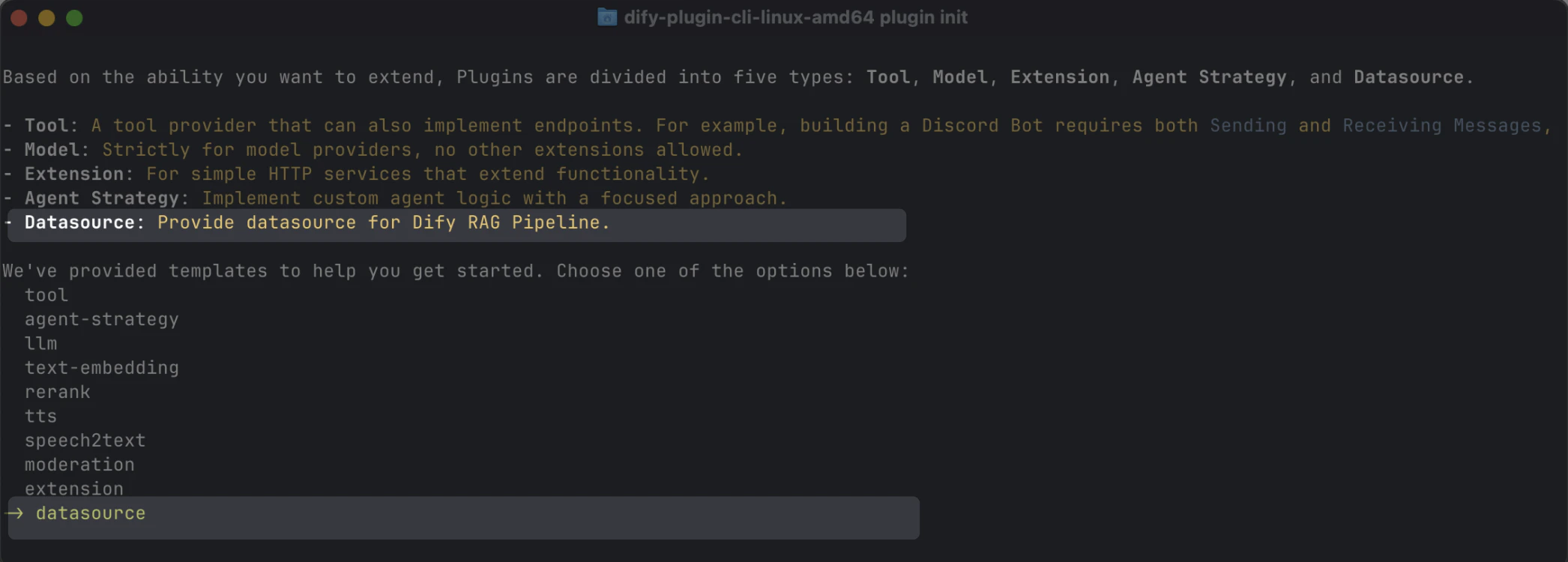
通常、データソースプラグインはDifyプラットフォームの他の機能を使用しないため、追加の権限を設定する必要はありません。
データソースプラグインの構造
データソースプラグインは、主に3つの部分で構成されています。
manifest.yaml ファイル:プラグインの基本情報を記述しますprovider ディレクトリ:プラグインプロバイダーの説明と認証を実装するコードが含まれますdatasources ディレクトリ:データソースを取得するコアロジックを実装する説明とコードが含まれます
├── _assets
│   └── icon.svg
├── datasources
│   ├── your_datasource.py
│   └── your_datasource.yaml
├── main.py
├── manifest.yaml
├── PRIVACY.md
├── provider
│   ├── your_datasource.py
│   └── your_datasource.yaml
├── README.md
└── requirements.txt
正しいバージョンとタグの設定
-
manifest.yaml ファイルでは、プラグインがサポートするDifyの最低バージョンを次のように設定する必要があります:
minimum_dify_version: 1.9.0
-
manifest.yaml ファイルで、プラグインに以下のデータソースタグを追加し、プラグインがDify Marketplaceでデータソースとして分類・表示されるようにする必要があります:
-
requirements.txt ファイルでは、プラグイン開発に使用するプラグインSDKのバージョンを次のように設定する必要があります:
dify-plugin>=0.5.0,<0.6.0
プロバイダーの追加
プロバイダーYAMLファイルの作成
プロバイダーYAMLファイルの定義と記述は、ツールプラグインと基本的に同じですが、以下の2点のみ異なります。
# データソースのプロバイダータイプを指定します。online_drive、online_document、または website_crawl に設定できます
provider_type: online_drive # online_document, website_crawl

# データソースを指定します
datasources:
  - datasources/PluginName.yaml
プロバイダーコードファイルの作成
-
APIキー認証モードを使用する場合、データソースプラグインのプロバイダーコードファイルはツールプラグインと完全に同じですが、プロバイダークラスが継承する親クラスを
DatasourceProvider に変更するだけで済みます。
class YourDatasourceProvider(DatasourceProvider):

    def _validate_credentials(self, credentials: Mapping[str, Any]) -> None:
        try:
            """
            IMPLEMENT YOUR VALIDATION HERE
            """
        except Exception as e:
            raise ToolProviderCredentialValidationError(str(e))
-
OAuth認証モードを使用する場合、データソースプラグインはツールプラグインと若干異なります。OAuthを使用してアクセス権限を取得する際、データソースプラグインは同時にユーザー名とアバターを返し、フロントエンドに表示することができます。そのため、
_oauth_get_credentials と _oauth_refresh_credentials は、name、avatar_url、expires_at、および credentials を含む DatasourceOAuthCredentials 型を返す必要があります。
-
DatasourceOAuthCredentials クラスの定義は以下の通りです。返す際には対応する型に設定する必要があります:
class DatasourceOAuthCredentials(BaseModel):
    name: str | None = Field(None, description="The name of the OAuth credential")
    avatar_url: str | None = Field(None, description="The avatar url of the OAuth")
    credentials: Mapping[str, Any] = Field(..., description="The credentials of the OAuth")
    expires_at: int | None = Field(
        default=-1,
        description="""The expiration timestamp (in seconds since Unix epoch, UTC) of the credentials.
        Set to -1 or None if the credentials do not expire.""",
    )
-
_oauth_get_authorization_url、_oauth_get_credentials、および _oauth_refresh_credentials の関数シグネチャは以下の通りです:
def _oauth_get_authorization_url(self, redirect_uri: str, system_credentials: Mapping[str, Any]) -> str:
"""
Generate the authorization URL for {{ .PluginName }} OAuth.
"""
try:
    """
    IMPLEMENT YOUR AUTHORIZATION URL GENERATION HERE
    """
except Exception as e:
    raise DatasourceOAuthError(str(e))
return ""
def _oauth_get_credentials(
self, redirect_uri: str, system_credentials: Mapping[str, Any], request: Request
) -> DatasourceOAuthCredentials:
"""
Exchange code for access_token.
"""
try:
    """
    IMPLEMENT YOUR CREDENTIALS EXCHANGE HERE
    """
except Exception as e:
    raise DatasourceOAuthError(str(e))
return DatasourceOAuthCredentials(
    name="",
    avatar_url="",
    expires_at=-1,
    credentials={},
)
def _oauth_refresh_credentials(
self, redirect_uri: str, system_credentials: Mapping[str, Any], credentials: Mapping[str, Any]
) -> DatasourceOAuthCredentials:
"""
Refresh the credentials
"""
return DatasourceOAuthCredentials(
    name="",
    avatar_url="",
    expires_at=-1,
    credentials={},
)
データソースの追加
3種類のデータソースプラグインでは、作成するYAMLファイル形式とデータソースコード形式が異なります。以下でそれぞれ説明します。
Webクローラー(Web Crawler)
Webクローラー系プラグインのプロバイダーYAMLファイルでは、output_schema は source_url、content、title、description の4つのパラメータを固定で返す必要があります。
output_schema:
    type: object
    properties:
      source_url:
        type: string
        description: the source url of the website
      content:
        type: string
        description: the content from the website
      title:
        type: string
        description: the title of the website
      "description":
        type: string
        description: the description of the website
WebsiteCrawlDatasource クラスを継承し、_get_website_crawl メソッドを実装した上で、create_crawl_message メソッドを使用してウェブクローラーメッセージを返す必要があります。
複数のウェブページをクロールし、バッチで返す必要がある場合は、WebSiteInfo.status を processing に設定し、create_crawl_message メソッドを使用して各バッチのWebクローラーメッセージを返すことができます。すべてのウェブページのクロールが完了したら、WebSiteInfo.status を completed に設定します。
class YourDataSource(WebsiteCrawlDatasource):

    def _get_website_crawl(
        self, datasource_parameters: dict[str, Any]
    ) -> Generator[ToolInvokeMessage, None, None]:

        crawl_res = WebSiteInfo(web_info_list=[], status="", total=0, completed=0)
        crawl_res.status = "processing"
        yield self.create_crawl_message(crawl_res)

        ### your crawl logic
           ...
        crawl_res.status = "completed"
        crawl_res.web_info_list = [
            WebSiteInfoDetail(
                title="",
                source_url="",
                description="",
                content="",
            )
        ]
        crawl_res.total = 1
        crawl_res.completed = 1

        yield self.create_crawl_message(crawl_res)
オンラインドキュメント(Online Document)
オンラインドキュメント系プラグインの戻り値には、ドキュメントの内容を表す content フィールドを少なくとも含める必要があります。以下に例を示します。
output_schema:
    type: object
    properties:
      workspace_id:
        type: string
        description: workspace id
      page_id:
        type: string
        description: page id
      content:
        type: string
        description: page content
OnlineDocumentDatasource クラスを継承し、_get_pages と _get_content の2つのメソッドを実装する必要があります。ユーザーがプラグインを実行すると、まず _get_pages メソッドを介してドキュメントリストを取得します。ユーザーがリストから特定のドキュメントを選択すると、次に _get_content メソッドを介してドキュメントの内容を取得します。
def _get_pages(self, datasource_parameters: dict[str, Any]) -> DatasourceGetPagesResponse:
    # your get pages logic
    response = requests.get(url, headers=headers, params=params, timeout=30)
    pages = []
    for item in  response.json().get("results", []):
        page = OnlineDocumentPage(
            page_name=item.get("title", ""),
            page_id=item.get("id", ""),
            type="page",
            last_edited_time=item.get("version", {}).get("createdAt", ""),
            parent_id=item.get("parentId", ""),
            page_icon=None,
        )
        pages.append(page)
    online_document_info = OnlineDocumentInfo(
        workspace_name=workspace_name,
        workspace_icon=workspace_icon,
        workspace_id=workspace_id,
        pages=[page],
        total=pages.length(),
    )
    return DatasourceGetPagesResponse(result=[online_document_info])
def _get_content(self, page: GetOnlineDocumentPageContentRequest) -> Generator[DatasourceMessage, None, None]:
# your fetch content logic, example
response = requests.get(url, headers=headers, params=params, timeout=30)
...
yield self.create_variable_message("content", "")
yield self.create_variable_message("page_id", "")
yield self.create_variable_message("workspace_id", "")
オンラインストレージ(Online Drive)
オンラインストレージ系プラグインの戻り値の型はファイルであり、以下の仕様に従う必要があります。
output_schema:
    type: object
    properties:
      file:
        $ref: "https://dify.ai/schemas/v1/file.json"
OnlineDriveDatasource クラスを継承し、_browse_files と _download_file の2つのメソッドを実装する必要があります。
ユーザーがプラグインを実行すると、まず _browse_files メソッドを介してファイルリストを取得します。このとき prefix は空で、ルートディレクトリ直下のファイルリストを取得することを示します。ファイルリストには、フォルダとファイルの2種類の変数が含まれます。ユーザーがさらにフォルダを開くと、_browse_files メソッドが再度実行されます。このとき、OnlineDriveBrowseFilesRequest の中の prefix はフォルダIDとなり、そのフォルダ内のファイルリストを取得するために使用されます。
ユーザーが特定のファイルを選択すると、プラグインは _download_file メソッドとファイルIDを介してファイルの内容を取得します。_get_mime_type_from_filename メソッドを使用してファイルのMIMEタイプを取得し、パイプラインで異なるファイルタイプに対して異なる処理を行うことができます。
ファイルリストに複数のファイルが含まれる場合、OnlineDriveFileBucket.is_truncated を True に設定し、OnlineDriveFileBucket.next_page_parameters をファイルリストの取得を続行するためのパラメータ(例えば、次のページの要求IDやURLなど、サービスプロバイダーによって異なります)に設定することができます。
_browse_files
_download_file
def _browse_files(
self, request: OnlineDriveBrowseFilesRequest
) -> OnlineDriveBrowseFilesResponse:

credentials = self.runtime.credentials
bucket_name = request.bucket
prefix = request.prefix or ""  # Allow empty prefix for root folder; When you browse the folder, the prefix is the folder id
max_keys = request.max_keys or 10
next_page_parameters = request.next_page_parameters or {}

files = []
files.append(OnlineDriveFile(
    id="",
    name="",
    size=0,
    type="folder" # or "file"
))

return OnlineDriveBrowseFilesResponse(result=[
    OnlineDriveFileBucket(
        bucket="",
        files=files,
        is_truncated=False,
        next_page_parameters={}
    )
])
def _download_file(self, request: OnlineDriveDownloadFileRequest) -> Generator[DatasourceMessage, None, None]:
credentials = self.runtime.credentials
file_id = request.id

file_content = bytes()
file_name = ""

mime_type = self._get_mime_type_from_filename(file_name)

yield self.create_blob_message(file_content, meta={
    "file_name": file_name,
    "mime_type": mime_type
})

def _get_mime_type_from_filename(self, filename: str) -> str:
"""Determine MIME type from file extension."""
import mimetypes
mime_type, _ = mimetypes.guess_type(filename)
return mime_type or "application/octet-stream"
prefix、bucket、id の各変数に特別な使用方法があり、実際の開発では必要に応じて柔軟に適用できます。
prefix: ファイルパスのプレフィックスを表します。例えば、prefix=container1/folder1/ は、container1 バケット内の folder1 フォルダにあるファイルまたはファイルリストを取得することを示します。bucket: ファイルバケットを表します。例えば、bucket=container1 は、container1 バケット直下のファイルまたはファイルリストを取得することを示します(非標準のS3プロトコルのオンラインストレージの場合、このフィールドは空にすることができます)。id: _download_file メソッドは prefix 変数を使用しないため、ファイルパスを id に連結する必要があります。例えば、id=container1/folder1/file1.txt は、container1 バケット内の folder1 フォルダにある file1.txt ファイルを取得することを示します。
プラグインのデバッグ
データソースプラグインは、リモートデバッグとローカルプラグインとしてのインストールの2つのデバッグ方法をサポートしています。注意点:
- プラグインがOAuth認証モードを使用している場合、リモートデバッグ時の
redirect_uri はローカルプラグインの設定と一致しないため、サービスプロバイダーのOAuth App関連設定を変更する必要があります。
- データソースプラグインはステップ実行デバッグをサポートしていますが、機能の正確性を保証するため、完全なナレッジパイプラインでテストすることをお勧めします。
最終チェック
パッケージ化して公開する前に、以下の項目がすべて完了していることを確認してください:
- サポートする最低Difyバージョンを
1.9.0 に設定する
- SDKバージョンを
dify-plugin>=0.5.0,<0.6.0 に設定する
README.md と PRIVACY.md ファイルを作成する- コードファイルには英語のコンテンツのみが含まれていることを確認する
- デフォルトのアイコンをデータソースプロバイダーのロゴに置き換える
パッケージ化と公開
プラグインディレクトリで以下のコマンドを実行すると、.difypkg プラグインパッケージが生成されます:
dify plugin package . -o your_datasource.difypkg
- あなたのDify環境にプラグインをインポートして使用する
- プルリクエストを送信して、Dify Marketplaceにプラグインを公開する
このページを編集する | 問題を報告する